domingo, 29 de abril de 2012

If You Got Video of Falling Meteor, NASA Wants You


Remember those mysterious booms that were heard around Novato on a sporadic basis, prompting residents to call police?

Maybe it was falling meteors. It's possible.

Get this: NASA and the Search for Extra-Terrestrial Intelligence Institute are asking for the public's help finding footage photos and video of a daylight meteor that fell over Northern California on Sunday, the NASA Ames Research Center announced Wednesday.

The meteor was sighted over the Sierra Nevada range shortly before 8 a.m. Sunday, causing a sonic boom heard throughout the area, researchers said. Through more photos and videos of the meteor, NASA and SETI researchers hope to analyze the trajectory of the meteor as it fell, lending insight into its orbit in space and where fragments of it may have landed on Earth.

Astronomer Peter Jenniskens of NASA Ames and the SETI Institute found a four-gram fragment of the meteor in a parking lot in the of Lotus, a Gold Country hamlet on the American River.

"This appears to be a rare type of primitive meteorite rich in organic compounds," Jenniskens said.

Anyone who took photos or video of the meteor has been asked to contact Jenniskens at petrus.m.jenniskens@nasa.gov.

Fonte: sonoma.patch.com

sábado, 28 de abril de 2012

Scientists: Mars 'egg' proof of life


SCIENTISTS claim this egg-shaped object is the final proof of life on Mars after finding it inside a meteorite from the Red Planet.

Professor Chandra Wickramasinghe said the globule from the rock named Tissint is rich in carbon and oxygen and insisted they could only have been produced by living organisms.

He added that they could not have been caused by contamination when they fell to Earth.

Prof Wickramasinghe, 72 — famous for controversial ideas such as that the flu virus and even life itself was brought to our planet by comets — said: "It is impossible to understand how carbon-rich particles of such uniform sizes and shapes got inside a rocky matrix if they are not relics of some algal species.

"Tissint was collected weeks after it fell, and terrestrial contamination seems unlikely. In any case the structures we found were on newly fractured surfaces, from the interior of the meteorite."

The meteorite was named after the village where it came down in the Sahara desert in Morocco last July.

It was probably blasted from Mars when it was hit by an asteroid millions of years ago.

A piece of it was examined at the Buckingham Centre for Astrobiology and Cardiff University.

PhD student Jamie Wallis, who was working with Dr Wickramasinghe, said: "All the indications are that structures such as we have found are evidence of life on Mars.

“The spheres are probably remnants of polysaccharide shells surrounding algal type cells."


In 2009, a NASA team claimed they had photographed Martian organisms inside another meteorite that is kept in London's Natural History Museum.

Their electron microscope showed a bumpy surface resembling a fossilised colony of microbacteria in a rock that fell from the sky in Nakhla, Egypt, in 1911.

The team from NASA's Johnson Space Centre examined the space rock to support their claims in 1996 that Martian bugs had been found in a meteorite, ALH84001, found in Antarctica where it had been lying for thousands of years.

That discovery, which NASA later officially backtracked from, was considered so important that President Clinton addressed the nation on TV.

Earlier this month, another group of scientists claimed that the first two Viking probes that NASA landed on Mars in 1976 discovered life but failed to recognise it.


Fonte: thesun.co.uk

quinta-feira, 26 de abril de 2012

Rare meteorites found in California along path of fireball


Robert Ward has been hunting and collecting meteorites for more than 20 years, so he knew he’d found something special in the Sierra foothills along the path of a flaming fireball that shook parts of Northern California and Nevada with a sonic boom over the weekend.

And scientists have confirmed his suspicions: it’s one of the more primitive types of space rocks out there, dating to the early formation of the solar system 4 to 5 billion years ago.

“It was just, needless to say, a thrilling moment,” Ward of Prescott, Ariz., told The Associated Press in a telephone interview Wednesday as he walked through an old cemetery in search of more meteorites about 35 miles northeast of Sacramento.

He found the first piece on Tuesday along a road between a baseball field and park on the edge of Lotus near Coloma, where James W. Marshall first discovered gold in California, at Sutter’s Mill in 1848.

Ward, who has found meteorites in every continent but Antarctica and goes by “AstroBob” on his website, said he “instantly knew” it was a rare meteorite known as “CM” — carbonaceous chondrite — based in part on the “fusion crusts from atmospheric entry” on one side of the rock.

“It is one of the oldest things known to man and one of the rarest types of meteorites there is,” he said. “It contains amino acids and organic compounds that are extremely important to science.”

Ward actually has two rocks but suspects they were part of the same small meteorite that broke on impact. Each weighs about 10 grams — about the same as two nickels. He said his only previous finds that rival this one were three lunar meteorites he found years ago in the Middle East.

Experts say the flaming meteor was probably about the size of a minivan when it entered the Earth’s atmosphere with a loud boom and about one-third of the explosive force of the atomic bomb. It was seen from Sacramento, Calif., to Las Vegas and parts of northern Nevada.

An event of that size might happen once a year around the world, said Don Yeomans of NASA’s Near-Earth Object Program Office at the Jet Propulsion Laboratory in Pasadena, Calif. “But most of them occur over the ocean or an uninhabited area, he said.

“Getting to see one is something special,” he said. He added, “most meteors you see in the night’s sky are the size of tiny stones or even grains of sand, and their trail lasts all of a second or two.”

The meteor probably weighed about 154,300 pounds, said Bill Cooke, a specialist in meteors at NASA’s Marshall Space Flight Center in Huntsville, Ala. At the time of disintegration, he said, it probably released energy equivalent to a 5-kiloton explosion — the Hiroshima bomb was 15 kilotons.

“You don’t often have kiloton rocks flying over your head,” he said.

The boom, another expert said, was caused by the speed with which the space rock entered the atmosphere. Meteorites enter Earth’s upper atmosphere at somewhere between 22,000 mph and 44,000 mph — faster than the speed of sound, thus creating a sonic boom.

The friction between the rock and the air is so intense that “it doesn’t even burn it up, it vaporizes,” said Tim Spahr, director of the Minor Planet Center at Harvard University.

John T. Wasson, a longtime professor and expert in meteorites at UCLA’s Institute of Geophysics and Planetary Physics, said he understood that in addition to Lotus, another small meteorite had been in nearby Coloma,

Bits of the meteor could be strewn over an area as long as 10 miles, most likely stretching west from Coloma, he said.

“I’m sure more will be found, I’m hoping, including some fairly big pieces,” Wasson said. “The fact that two pieces already have been found means one knows where to look.”

Wasson suspected hundreds of dealers and collectors already have joined the search. He said it was important to recover the meteorites soon because any rain will cause them to degrade, losing their sodium and potassium.

“From my viewpoint as a meteorite researcher,” he said, “I’m hopeful some big pieces are found right away.”

Yeomens confirmed this type of meteorite is one of the oldest, dating to the origin of the solar system 4 to 5 billion years ago. And it’s “actually kind of unusual,” he said.

Yeomens said it’s got two of the most important chemicals that scientists look for: carbon and a form of water. In fact, this type of space rock is likely full of water and would have made a good candidate for the new space company announced Tuesday that plans to mine asteroids, he said.

“And this one landed in their backyard for a lot less than they planned to spend,” he said.

The mini-van sized asteroid wasn’t on NASA’s lengthy list of near Earth objects that they track coming close to the planet, so it took scientists by surprise. “There are millions of objects of that size that we don’t know about,” he said. “They’re too small to image unless they’re right up on top of you.”


Source: nydailynews.com

quarta-feira, 25 de abril de 2012

Meteor Produces Sound and Fury


A fiery meteor created a thundering explosion and traced a rare daylight fireball seen for about 600 miles across Nevada and California on Sunday, before apparently breaking up harmlessly at high altitude, astronomers said.


NASA researchers at the Jet Propulsion Laboratory said the midair explosion, centered over California's Central Valley east of the San Francisco Bay area, was the equivalent of the detonation of about 3.8 kilotons of TNT—about one quarter the energy released by the atomic bomb dropped on Hiroshima, Japan, in 1945.

"The meteor was probably about the size of an SUV," said Donald Yeomans, manager of NASA's Near-Earth Object Program Office at the laboratory, in Pasadena, Calif. "This was a big one. An event of this size might happen about once a year, but most of them occur over the ocean or an uninhabited area."

There were no reports Monday that any fragments of the object had reached the ground or caused any damage. No major telescope in the region tracked the early-morning fireball. NASA astronomers said the explosion might have been five to 10 miles high, which was high enough to let the sound spread widely.

Each day, countless meteors reach Earth's atmosphere. Most are smaller than a grain of sand, according to the American Meteor Society, and usually burn up before they hit Earth's surface.

Sunday's eye-catching event occurred at the height of the annual Lyrid meteor shower, which happens every April as Earth plows through the dust and debris trailing a comet called Thatcher. People have been observing its annual shower of shooting stars for more than 2,600 years. Astronomers usually expect about 20 meteors per hour during the Lyrid shower, with outbursts as high as 100 meteors per hour.

Generally, comet debris can hit Earth's atmosphere at speeds as fast as 110,000 miles per hour. The heat from the friction of its descent into the denser air can ignite the dust and debris in a display of astronomical fireworks. Skywatchers have reported dazzling fireballs, like Sunday's, during Lyrid showers in previous years.

In the far distant past, immense meteorites—meteors that slam into Earth—likely contributed to the demise of the dinosaurs. The largest meteorite found weighs nearly 60 tons. Called Hoba, it is an iron boulder thought to have landed about 80,000 years ago, in present-day Namibia.

On rare occasions, the falling bits of space debris do hit now-populated areas. There is no record of anyone ever having been killed by a meteorite, but in recent years, there have been verified accounts of a meteorite hitting a bedroom in Alabama, a dining room in Connecticut and a parked car in Peekskill, N.Y.


Source: online.wsj.com

sexta-feira, 20 de abril de 2012

Conheça o meteorito que vale mais de Mil Milhões de Euros e tem uma beleza de tirar a respiração

Chamado de Fukang, peça única é uma das maiores descobertas do século 21


O meteorito Funkang, encontrado na superfície da Terra, chama a atenção pela sua beleza de tirar o fôlego. Foram encontrados cristais dourados de um mineral chamado olivina.
Ao cortar o meteorito, os pedaços criam um efeito de vidro colorido quando exposto ao sol.
Um colecionador anônimo tem em mãos a maior parte do meteorito, chegando a pesar quase 420 kg.
Em 2008, essa peça estava no Leilão de Bonham, Nova York, na expectativa de ser vendido por R$ 3,7 milhões (1.26 milhões de libras), o que não ocorreu.
Segundo o Laboratório de Meteorito do Sudoeste do Arizona, que possui 32 Kg da peça, ele será uma das maiores descobertas do século 21.
Meteorito é a denominação dada quando um meteoroide, formado por fragmentos de asteroides ou cometas ou ainda restos de planetas desintegrados, alcançam a superfície da Terra.

Fonte: Noticias.r7.com

quarta-feira, 18 de abril de 2012

Michael Callahan finds meteorites might seed Earth life


New evidence from meteorites supports the ongoing speculation that life on Earth might have been seeded from space.

New evidence from meteorites supports the ongoing speculation that life on Earth might have been seeded from space.

Research published in August, 2011 in the Proceedings of the National Academy of Sciences – suggests that meteorites are likely the source of certain nucleobases – the building blocks of our genetic material on Earth – in greater diversity and quantity than scientists previously thought.


Meteorite found in Saudi Arabia. Via Wikipedia

EarthSky spoke with research physical scientist Michael Callahan of the NASA Goddard Spaceflight Center, lead author of the August 2011 study. He said:

Our research results have shown the nucelobases, which are the building blocks of your genetic material, DNA, are found in meteorites. That result wasn’t so new, in that people have known this for actually the last 50 years or so. But no one’s been able to prove definitively if these building blocks of DNA were extraterrestrial in origin or if they were the remnants of terrestrial contamination in the meteorite.

The evidence, said Callahan, comes from 12 meteorites, nine of which landed on Antarctica. They contain not only the chemical building blocks of DNA, but other molecules produced from simple ingredients found in space, such as water and ammonia. He said:

Now if those components can be used later on, which is what the idea is of why this would be so important, these meteorites could have brought in some important ingredients that may have assisted the origin of life.

Because they moved in space, remaining pristine, until they fell to Earth, meteorites hold a record of chemicals that existed in the early solar system. Some of these chemicals might have been a crucial source of the organic compounds that gave rise to life on Earth. Since the 1960s, scientists have been trying to find proof that nucleobases came to Earth on meteorites.

Extensive research has shown that amino acids, which string together to form proteins, exist in space and have arrived on our planet piggybacked on a type of organic-rich meteorite called carbonaceous chondrites. But it has been difficult to prove that the nucleobases found on meteorite samples are not due to contamination from sources on Earth.


Examples of carbonaceous chondrites. Via Wikimedia

The research team, which included Jim Cleaves of the Carnegie Institution for Science Geophysical Laboratory, used advanced spectroscopy techniques to purify and analyze samples from 11 different carbonaceous chondrites and one ureilite, a very rare type of meteorite with a different chemical composition. This was the first time all but two of these meteorites had been examined for nucleobases.

Two of the carbonaceous chondrites contained a diverse array of nucleobases and compounds that are structurally similar, so-called nucleobase analogs. Especially telling was the fact that three of these nucleobase analogs are very rare in terrestrial biology. What’s more, significant concentrations of these nucleobases were not found in soil and ice samples from the areas near where the meteorites were collected.


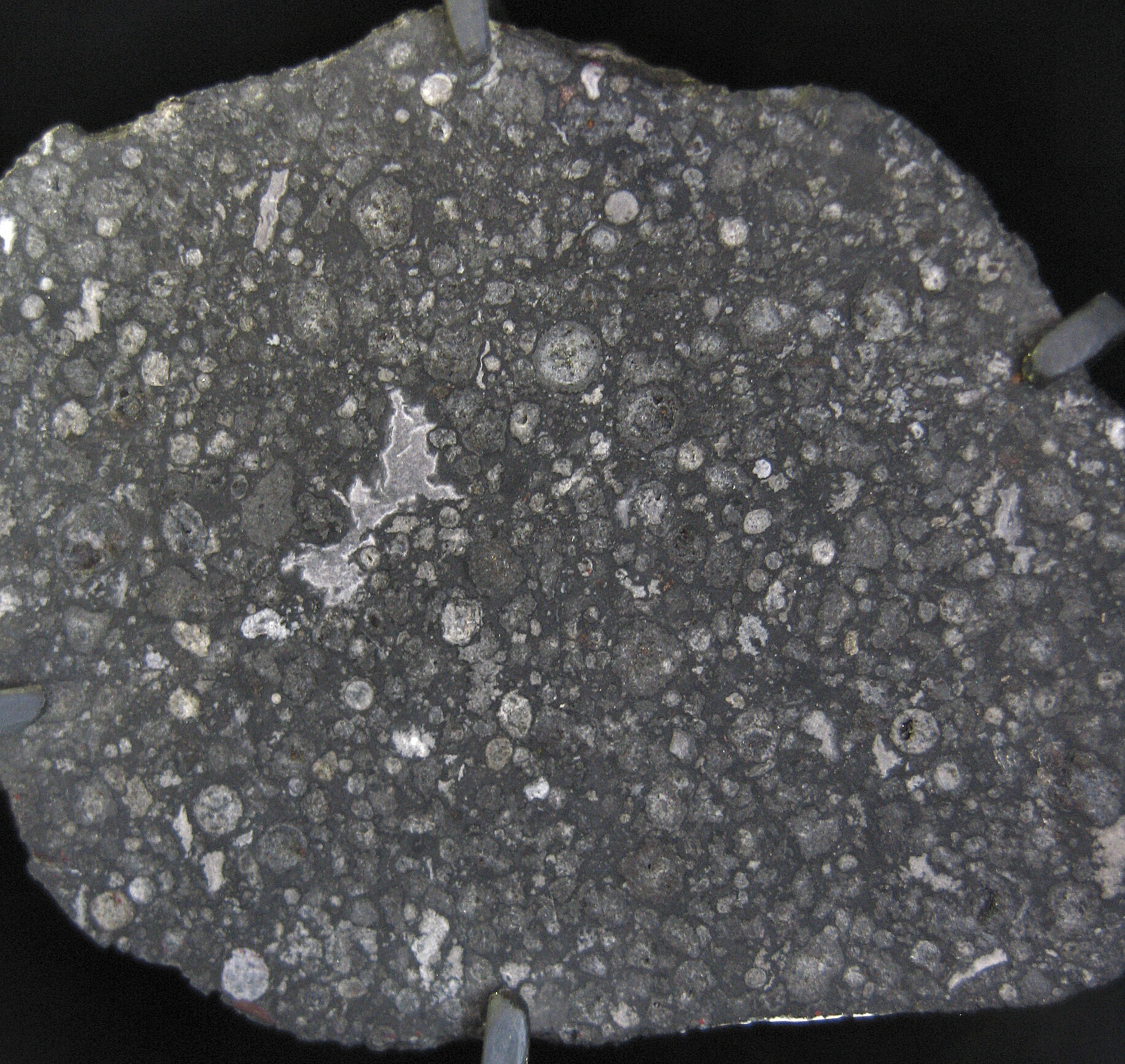
A slice of the 4.5-billion-year-old Allende meteorite, pictured on the left in the image above. Via Wikimedia

Cleaves said:


Finding nucleobase compounds not typically found in Earth’s biochemistry strongly supports an extraterrestrial origin.

The team tested their conclusion with experiments to reproduce nucleobases and analogs using chemical reactions of ammonia and cyanide, which are common in space. Their lab-synthesized nucleobases were very similar to those found in the carbonaceous chondrites, although the relative abundances were different. This could be due to chemical and thermal processing that the meteorite-origin nucleobases underwent while traveling through space.

The results of the study have far-reaching implications: the earliest forms of life on Earth might have been assembled from materials delivered to Earth by meteorites.

Callahan spoke of an intense period of meteorite impacts on both the Earth and the moon around four billion years ago.

So maybe, these meteorites are flying all over the universe impacting different objects and bringing some pretty important things. And maybe, if the conditions are right, maybe the same sort of process for life could be happening elsewhere. So the likelihood of life elsewhere has kind of increased, just a little bit more.


Source: Earthsky.org

Rocks from Space


Michael Callahan knows that he has a great job every time a meteorite sample arrives at the laboratory from NASA's meteorite archive in Houston, Texas. “There's no cooler feeling than working with a meteorite in the lab,” he says.


Callahan, an analytical chemist at the Astrobiology Analytical Laboratory at NASA's Goddard Space Flight Center in Greenbelt, Maryland, is one of a growing number of researchers around the world working in astrobiology — the exploration of how and where life might have emerged in the Universe.


ESA/DLR/FU BERLIN/G. NEUKUM


Images from the surface of Mars: analysing these may form part of an astrobiologist's role.


The breadth of astrobiology can be daunting. Because the field focuses on questions about the origins of life, it incorporates aspects of astronomy and physics as well as chemistry, geology, oceanography, microbiology and bioinformatics. As a result, there are many different routes to a career in astrobiology; Callahan, for example, started out as an analytical chemist in industry. Exobiology — the study of the possibility of life on other planets — thrived with origins-of-life research in the 1950s and '60s, and really took off with the space exploration programmes in the 1960s and '70s. Later, when the astrobiology label took hold, some people questioned the field's seriousness, notes Zita Martins, an astrobiologist at Imperial College London. Many different types of researchers now contribute to the field; geomicrobiologists look for extremophiles — organisms that live in extreme environments such as deep caves or hot springs; astronomers search for chemical signs of metabolism on other planets; and biologists investigate how life on Earth first appeared.


Martins, for example, works in the department of Earth science and engineering, developing techniques for uncovering microbial life and metabolism in extreme settings, using soil samples from the Utah desert as stand-ins for samples from Mars. She collaborates with soil scientists, geochemists, biologists and robotics engineers who specialize in exploration. “That's the beauty of the astrobiology field. It's scientists from different research fields, working together,” she says. NASA has an annual conference dedicated to the field, which is taking place this week in Atlanta, Georgia.
Joint missions


Support for astrobiology research is spread across many funding streams and disciplines, and finding funding and jobs that are strictly astrobiology-related is difficult, especially given recent budget woes. NASA and the European Space Agency (ESA) support the largest number of astrobiology-related positions, whether they are in Earth-science observation or engineering jobs on the next space mission. But NASA is facing budget cuts that have alarmed researchers in the field. For 2012 and 2013, a slight increase in the budget for human space exploration, from US$3.7 billion to a proposed $3.9 billion, was countered by a decrease for the science directorate, including planetary-science research, from $5.1 billion to a proposed $4.9 billion. The agency has withdrawn its component of the ExoMars programme — a joint mission with ESA to send an orbiter and rover to look for methane on the red planet, which is scheduled for 2018. NASA's funding would have created more research positions for biologists and instrumentalists, among others.


Although the US Terrestrial Planet Finder — a mission intended to look for Earth-sized planets in the habitable zones of distant solar systems — has been suspended, astronomers hope that NASA's James Webb Space Telescope, an observational mission with similar planet-finding goals, will continue moving forward.


NASA/JPL-CALTECH/ASU


Noctis Labyrinthus, a region of the red planet captured by NASA's Mars Odyssey orbiter.


Despite cuts in some areas, NASA's Earth budget is up slightly from $1.76 billion in 2012 to $1.79 billion in 2013, notes geochemist Mitchell Schulte, a programme officer for the Mars Exploration Programme at NASA headquarters in Washington DC. That means that research done on this planet but with applications off-planet could still be awarded funding, such as hunting for extremophiles and their proteins, or remote-sensing research such as LiDAR (a technique for detecting water, or mapping minerals and topography).


The Centre for Astrobiology in Madrid, which was established in 2000 as a partner to the NASA Astrobiology Institute based in Mountain View, California, is an example of an organization that is crucial for strengthening ties between researchers around the world, says astrophysicist Lisa Kaltenegger, who holds dual positions at the Harvard-Smithsonian Center for Astrophysics in Cambridge, Massachusetts, and the Max Planck Institute for Astronomy in Heidelberg, Germany.


In addition to NASA's partner centre in Spain, other centres have sprung up, including Germany's Institute of Planetary Research in Berlin, which is a cooperative alliance of about 200 scientists across 17 science organizations, with funding from the Helmholtz Alliance based in Bonn, which studies planetary evolution. Gerda Horneck, a former deputy director of the German Aerospace Centre's Institute of Aerospace Medicine in Cologne, says that there are now 25 PhD candidates in the Helmholtz Space Life Sciences Research School, based in various locations in Germany.


For fledgling scientists in the field, the economic climate means that success can hinge on finding multiple funding sources. Julie Huber, a microbial oceanographer at the Marine Biological Laboratory in Woods Hole, Massachusetts, whose research focuses on life at deep hydrothermal vents, says she applies for grants from NASA and the US National Science Foundation for oceanography programmes and occasionally from the US National Institutes of Health for microbiology research. She also applies to private foundations such as the Gordon and Betty Moore Foundation in California and the Alfred P. Sloan Foundation in New York. Huber says she considers herself lucky to have secured funding, given the budget woes of government agencies and the state of the foundations' endowments. “It used to be you had to write one or two grants to support yourself for five years,” she says. “Now it's four, five, six grants every year, with no growth in the pool of money.”


Other initiatives have helped to augment support for the field. The CAREX project from the European Union's Seventh Framework programme for research, which coordinated the study of life in extreme environments, wrapped up this year after spending €1.4 million (US$1.8 million). Its data on desert life, specifically microbial diversity and aspects of life in extreme environments, could help to inform surveys for life on Mars, although it is not labelled as astrobiology. The next round of European funding, Horizon 2020, will include support especially for astrobiology and space exploration, says Horneck. How much support is still under discussion. Up to this point, various projects across partnered universities and institutes have received about €2 million over three years from the European Union for cooperative astrobiology research, the CAREX funding being one example.
Space school


ASA/JPL-CALTECH/T. PYLE (SSC)


Astrobiologists hope to continue to study stars such as 51 Ophiuchi (artist's rendition pictured).


Few PhD programmes award astrobiology degrees; students typically earn their degree in a field such as analytical chemistry or microbiology but focus on astrobiology for their thesis. For example, the University of Washington in Seattle confers a certificate in astrobiology for graduate-level research, but graduate students retain their home-department affiliation for their doctorate. Graduates with this certificate have gone on to work as astrobiologists or in related fields at NASA or other institutes.


In 2005, Stockholm University launched an astrobiology graduate school for an initial five years to gauge interest in the field, a sort of interdisciplinary curriculum experiment. The university considered it a success, and departments including astronomy and geology have transferred their experience into the newly created astrobiology centre.


Sandra Siljeström's career exemplifies the potential myriad roles an astrobiologist can have. A graduate from the Stockholm programme who trained as a geochemist, Siljeström is now a research scientist at the government-run SP Technical Research Institute of Sweden in Borås, where she works on projects for the Swedish space board, developing methods to examine small amounts of organic compounds using time-of-flight spectroscopy. She is also helping to develop the Mars Organic Molecule Analyser, an instrument to be carried on the ExoMars rover. Her position also includes contract work for industry, examining organic compounds in rocks and other materials.
More bodies


Horneck advises undergraduates and master's students to ground themselves in one of the many applicable sciences before moving on to astrobiology-related research. She says getting a solid grounding in their field before pursuing astrobiology is important.


However, Malcolm Walter, director of the Australian Centre for Astrobiology at the University of New South Wales, advises students to start taking astrobiology courses at the undergraduate level if they are available. “The skills are generic and can be applied to many career paths. Being interdisciplinary, thinking in an interdisciplinary fashion leads to many career opportunities,” he says. “I look for people who are willing to take this risk. In my experience, that's an extraordinarily hard thing to do.”


" I look for people who are willing to take this risk. In my experience, that is an extraordinarily hard thing to do. "


Walter says two of his PhD students recently ended up working for NASA — one as a classical geologist at the Jet Propulsion Laboratory in Pasadena, California, and the other as a mineral spectroscopist, mapping mineralogy on the surface of Mars. Other students have gone on to work for biotechnology firms or the booming Australian mining industry.


Horneck worries that talented graduates will leave the field because few jobs exist outside NASA, ESA and academia, and even there, positions are limited. Many projects are suited to PhD theses, but not to full-time jobs. Not enough opportunities exist for bright doctorates to continue their research. “This is something that needs attention,” she says. Even so, student interest portends good things for the field. “Ten years ago, there were no courses. Now it's a field very much taken up by students,” Horneck says. Despite the challenges, she foresees a burgeoning field, with more discoveries on the horizon.


Source: Nature.com